
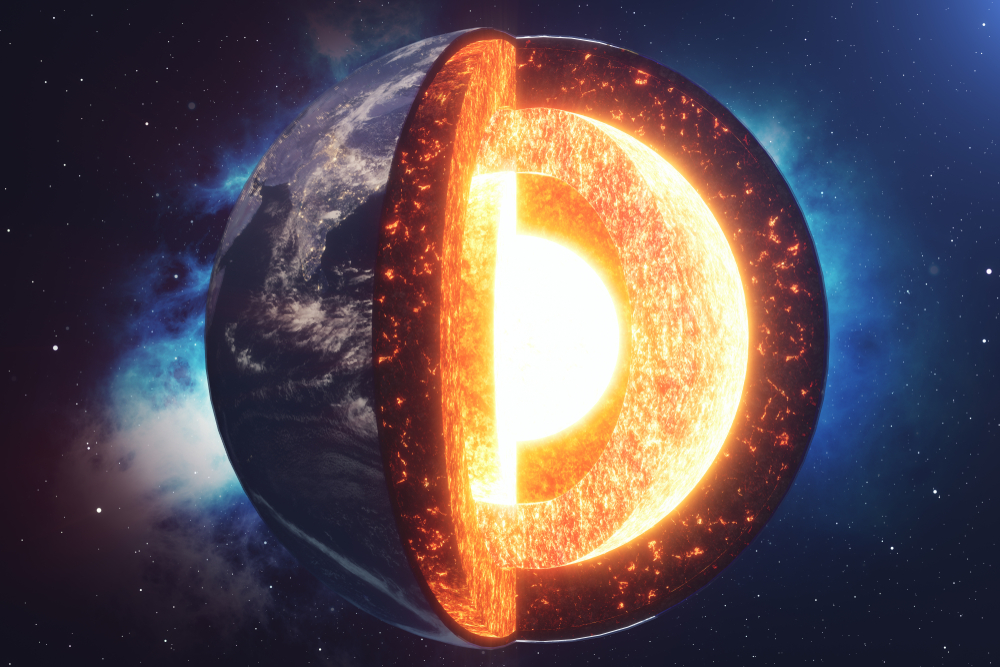
Deep beneath our feet, a secret rhythm pulses within the Earth’s core—a dynamic, swirling dance that has captivated scientists for decades. Far from the reach of human instruments, this mysterious inner core spins like a celestial body trapped within our planet, its movement hinting at the hidden forces shaping our world.
Recent studies suggest a surprising twist in this tale: the inner core’s spin may be slowing down, sparking questions about what this could mean for the Earth’s magnetic field, day length, and even the future of our planet. While the effects remain imperceptible to daily life, the implications stretch far beyond what meets the eye.
What lies at the heart of this discovery? And how does a slowing inner core impact the Earth as we know it?

Understanding the Earth’s Inner Core
Beneath our feet, at the heart of our planet, lies one of the greatest mysteries of Earth science—the inner core. Discovered in 1936 by Danish seismologist Inge Lehmann, the inner core was revealed through her studies of seismic waves generated by earthquakes. These waves, she found, behaved in unexpected ways as they traveled through the Earth, suggesting the presence of a solid sphere nestled within the molten outer core. This discovery has since painted a picture of a planet far more dynamic and complex than previously imagined.
Composed primarily of iron and nickel, the inner core is a solid metallic ball with a radius of about 1,220 kilometers (about 760 miles). 70% as wide as the Moon! Despite temperatures that rival the surface of the sun—around 5,700 degrees Celsius (about 10,300 degrees Fahrenheit)—this iron core remains solid due to the immense pressures that exceed 3 million times the atmospheric pressure at the Earth’s surface. This extreme environment makes the inner core one of the most fascinating yet inaccessible places in the solar system.
The inner core is not just a static ball of metal. It plays a pivotal role in the life of our planet. It is essential for generating Earth’s geomagnetic field through the dynamo effect, where the movement of the liquid outer core around the solid inner core creates and sustains our magnetic shield. This magnetic field is crucial, directing compass needles worldwide and protecting life by deflecting harmful solar radiation and preserving our atmosphere from solar winds.

Recent research has shown that the inner core itself is dynamic and evolving. It appears to be growing slightly faster on one side than the other, influencing the geomagnetic field and potentially impacting everything from global navigation systems to the behavior of the atmosphere itself. Intriguingly, scientists have also detected seismic activity originating from within the inner core, suggesting that it may host complex structural changes or movements akin to earthquakes.
The Inner Core Is Slowing Down: The Discovery
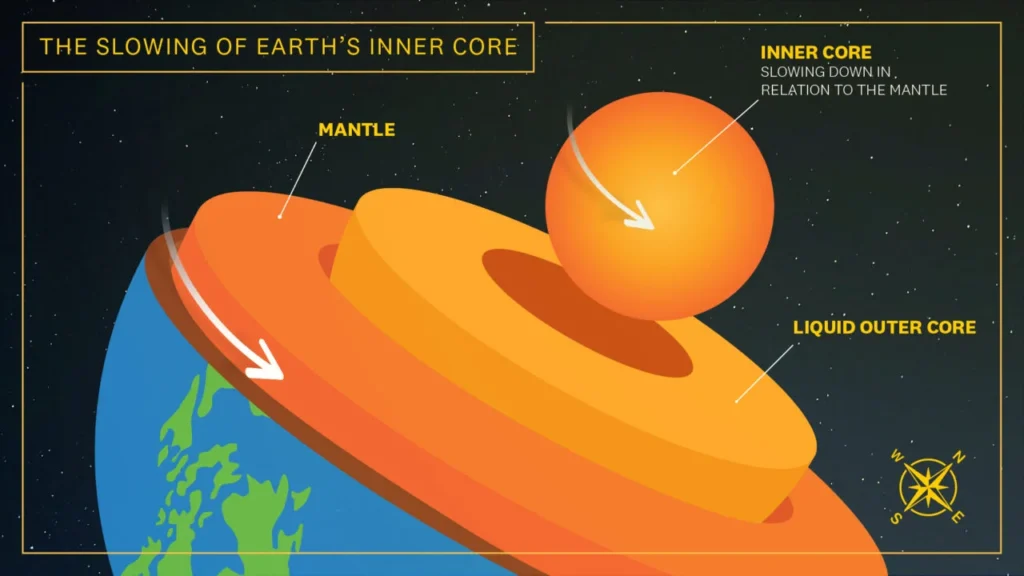
The concept of the inner core’s differential rotation emerged in the 1970s and ’80s, gaining traction in the ’90s with seismological evidence. By analyzing seismic waves from earthquakes traversing the inner core, scientists observed variations in wave behavior over time, suggesting that the inner core rotates at a different rate than Earth’s surface. This differential rotation is believed to be influenced by the dynamic interactions between Earth’s magnetic field and gravitational forces.
A pivotal 2023 study published in Nature Geoscience by researchers from Peking University analyzed seismic data from the 1960s to 2021. Their findings indicated that the inner core’s rotation had nearly halted around 2009 and might have even reversed direction. The researchers proposed that this phenomenon is part of a 70-year oscillation cycle, wherein the inner core alternates between rotating slightly faster and slightly slower than the Earth’s surface.
Further supporting this concept, a 2024 study published in Nature by scientists from the University of Southern California provided unambiguous evidence that the inner core began to decrease its speed around 2010, moving slower than the Earth’s surface. This study reinforced the idea of a decadal oscillation in the inner core’s rotation.
As Dr. John Vidale, a seismologist at the University of Southern California, remarked, “When I first saw the seismograms that hinted at this change, I was stumped. But when we found two dozen more observations signaling the same pattern, the result was inescapable.”
How the Core’s Movement Impacts Earth
The inner core’s rotation plays a pivotal role in Earth’s geophysical phenomena, particularly influencing the planet’s magnetic field and the length of a day. The motion of the liquid iron outer core, which surrounds the solid inner core, generates Earth’s magnetic field through the geodynamo process. The inner core’s rotation contributes to stabilizing and sustaining this magnetic field.
The deceleration could potentially affect the dynamics of the outer core and, consequently, the Earth’s magnetic field. However, any changes are expected to be subtle and occur over long timescales.
Additionally, the inner core’s rotation influences Earth’s rotation rate, thereby affecting the length of a day. As the inner core’s rotation slows, it may cause slight variations in the planet’s rotation rate. However, these changes are expected to be on the order of milliseconds and would not be noticeable in everyday life.
Understanding the inner core’s behavior is crucial, as it plays a significant role in generating Earth’s magnetic field and can influence phenomena such as the length of a day. However, due to the inner core’s inaccessibility, much of its dynamics remain shrouded in mystery, with ongoing research striving to unravel its secrets.
The Ongoing Debate
The rotation of Earth’s inner core has been a subject of scientific debate for decades. Despite the recent findings, the scientific community remains divided. Some researchers argue that observed changes in seismic wave travel times could be attributed to physical alterations on the inner core’s surface rather than changes in its rotation.
Others suggest that the inner core’s movement is more complex than a simple oscillation and may involve irregular patterns influenced by interactions with the outer core and mantle.
The challenges in studying the inner core stem from its inaccessibility; scientists rely on indirect measurements, such as seismic wave analyses, which can lead to varying interpretations. As a result, while recent studies have provided valuable insights, the exact nature of the inner core’s rotation and its implications for Earth’s geodynamics remain active areas of research and debate.
As Dr. John Vidale, a seismologist at the University of Southern California, noted, “Other scientists have recently argued for similar and different models, but our latest study provides the most convincing resolution.”
The Pulse of Our Planet
The discovery of the Earth’s inner core’s slowing rotation is a testament to the complexity and dynamism of our planet’s hidden layers. While imperceptible in our daily lives, the changes deep beneath our feet influence magnetic fields, seismic activity, and even the length of a day. These revelations remind us that our world is constantly evolving, driven by forces both seen and unseen.
The ongoing research into the inner core’s rotation underscores the importance of scientific curiosity and collaboration. As technology advances and new methods emerge, the mysteries of Earth’s interior will continue to unravel, offering deeper insights into the forces that shape our planet. For now, the slowing spin of the inner core stands as a captivating reminder of the interconnectedness of Earth’s layers and the intricate dance that keeps our world in motion.

